
Google Fraud
Google Screws the Consumer
WHAT IS THE GOOGLE BLACKLIST
When a website is in a blacklist, the search engine is expelling a
site from their list. When a website is blacklisted, it loses almost
95% of its organic traffic, which can rapidly affect revenue.
https://www.webarxsecurity.com/what-is-google-blacklist/
Use Virustotal to see if your website is listed on the known blacklist.
Google admits organic results are filler to pump deceptive ads at consumers.
10/5/2015
Google's DoubleClick Ad Exchange
Fraud is a million $ business; Here's how they're doing it by
Mike Nolet
Here lies the problem... there is no downside in trying. Law
enforcement doesn't do anything here so nobody is going to jail.
What happens is that fraudsters just keep trying and trying and
eventually make money. The only question is how much.
How to remove ads by SafeGuard
-
1/19 /15 click fraud level amounted to $6 billion that year, which
was 15% of the world market of contextual advertising in 2013.
ScroogeFrog.com, which can be set up within advertising networks
like AdWords to block fraudulent IPs and sites from seeing your ads.
Bots amounted to 61.5% of all internet traffic - with the majority
considered “good bots” as seen below:
http://www.acquisio.com/blog/sem/click-fraud-problem-and-potential-protection
http://www.adometry.com/blog/click-fraud-report-infographic/
7/7/14 How Google Map Hackers Can Destroy a Business at Will the premise of the lawsuit—that the Serbian Crown was sabotaged online—isn't as farfetched as it might seem. Beneath its slick interface and crystal clear GPS-enabled vision of the world, Google Maps roils with local rivalries, score-settling, and deception. These attacks happen because Google Maps is, at its heart, a massive crowdsourcing project, a shared conception of the world that skilled practitioners can bend and reshape in small ways using tools like Google's Mapmaker or Google Places for Business. Google seeds its business listings from generally reliable commercial mailing list databases, including infoUSA and Axciom. Once it's in Google's index, a business owner can claim a listing through Google and begin curating it for free, adding photos, hours of operation, a website address. Once your have that relationship with Google, the company will upsell you on paid advertising, which, after all, is Google's financial lifeblood. But if you ignore your Google Maps listing, you're inviting trouble. Ordinary users can submit community edits to your listing with details like operating hours. Fake map listings are a less tractable problem. Google allows anyone to enter a new business into Maps, and to place it wherever they like. The company keeps the listing invisible until it's been verified through old fashioned snail-mail. Google sends out a postcard with a PIN code, and the business owner activates the listing by typing in the PIN. The system has loopholes though, and troves of money-hungry spammers looking for weaknesses.
Tell Google about your issue
October 23, 2000, will be a date forever remembered by internet marketers around the globe, as this was the birth of the first ever self-serve online advertising platform - Google AdWords. 2011 Earnings
From forget SEO: Consumers are getting screwed. Google recently ran AdWords ads with the following copy when consumers searched Google for SEO information: “Forget about SEO. To be visible in Google today, try Adwords” You know Google's slogan: "maybe the best ads are just answers ." And sometimes they are misdirection or scams that quite literally kill people .
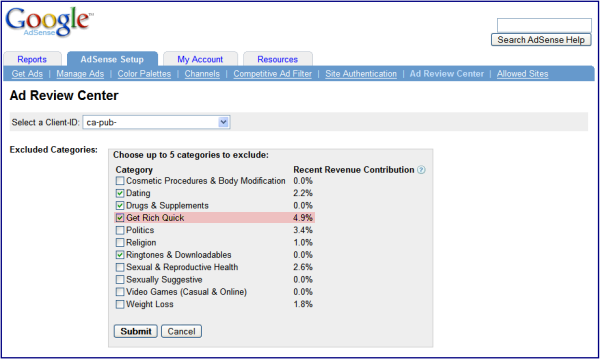
Learn about Google click fraud and cheating with their own paid links .
Not Adding Up (Literally) - Google AdWords' Glitch
2012
How it earns its money; how those advertising revenues are linked
to the way its search results are published; how it splits
revenues with partner sites; how it acquires traffic; and how it
is targeting key industry verticals. It's a complex business. The
Internet is a media publishing and distribution technology and so
that's where you'll find the disruption: in the media industry.
Google's battle with spammers, will cause hyperlink could
disappear in its current form, and become a commercial product
that's bought and sold, instead of earned fair and square.
Google's war on spam sites is tipping the online world upside down
and now threatens that most fundamental element of the world wide
web: the hyperlink. There is a massive erasure underway of millions
of links and it will only accelerate.
Google's biggest failure is in making dodgy SEO practices
irrelevant. The variants of the Panda algorithm released this year
are its most recent attempts to kill SEO and clean spam/low quality
content from its search results -- but with mixed results.
It's not your job to create content for Google
It's their job to find the best of the web for their results. Your audience is your readers, not Google's algorithm.
Matt Cutts: "Optimize your content for your readers -- not for the search bots. Let the search engines optimize themselves."
Killing the HyperLink is Google's big brand focused strategy at
the expense of small businesses because it makes all hyperlinks
potentially toxic. All hyperlinks, that is, except those
provided by Google.
Google's Panda algorithm launched in 2011 measures the "quality" of
each page in its index. Panda is atrocious at measuring the quality
of content. What used to be best practices for ensuring a high
Google rank: lots of links from lots of other sites, has now turned
into a massive marker pointing to an over-optimized, deceitful site.
To sink a competitor's high rank in Google is now possible, we now
have negative SEO. You pay for thousands of links on low quality web
sites to point to your competitor. Google thinks they are spamming
its index and sinks them like a rock. If you enjoy a high rank from
Google because other sites have linked to you for pure reasons, but
now those sites are measured by Panda to be low quality, you could
be in trouble. Negative SEO will quickly become a war of attrition
that no one can win if everyone does it. The only losers are the
ones that don't do it. There's now very little incentive for anyone
to link to other sites, and all types of risks if you do.
LOW LEVEL CONTENT BUILT FOR BOGUS CLICKS
Rat Out Your Competitor Spam Report Form
Are your competitors reaching the top of Google (and Bing) through
spammy SEO tactics? Let us know about it. We'll look into it and
report it directly to our connections at Google.
PLEASE NOTE: This is an experiment to see if Google actually cares
about how websites get to the top of their search results. Our guess
is that they don't, or they would have done something about it a
long time ago.
4/12/2012 Google has been accused of profiting off of serving illegal ads related to online pharmacies , illegal Olympic ticket sales , and recently lost a case in an Australian court related to being " engaged in misleading and deceptive conduct ." Now, the National Association of Human Trafficking Victim Advocates (NAHTVA) along with 37 other prominent anti-trafficking organizations i accusing Google of profiting off of the trafficking of women and demanding an investigation. In an open bi-partisan letter to Google CEO Larry Page, Republican Marsha Blackburn and Democrat Carolyn Maloney said the following:
"Whatever Google is doing or is not doing to prevent these sorts of advertisement from appearing on their properties, Google has not satisfied a significant number of human rights organizations who have a specialized understanding of how these ads contribute to the trafficking of women and girls."
2/1/11 SEO Driven Content that Produces Content Farms
Demand Media gets set for an IPO. Demand owns eHow, LiveStrong.com, and several other properties that often get labeled as “content farms,” and is reportedly going to go public next week. AOL, with Seed.com and Yahoo, with its Associated Content purchase last year, are also in the content farm business. Peter Kafka from AllThingsD has an excellent interview with Demand Media CEO Richard Rosenblatt who says the Google blog post “is not directed at us in any way.” At the end, Rosenblatt talks of having a synergistic relationship with Gogole, since they both “fill gaps” in Google's index and earn Google lots of money by carrying Google's AdSense ads. That will suggest these two things are tightly linked — Google's not going to do something to hurt one of its major ad partners. That suggestion is the type of thing that will give Google's PR team nightmares, since the company has been adamant that ads and listings are entirely disconnected.
Sick of your competitor?
How you and Google are losing the battle against spam in search results
Dear Google Stop Making me Look Like a Fool
Content farms like Demand Media, which raised $151 million in an initial public offering Wednesday, and AOL have created businesses that pay writers - or anyone who can reasonably string sentences together - to post content that answers popular search queries. AOL's Seed division offers low-paid writing assignments based on hot topics. Demand Media, particularly through its eHow Web site, specializes in how-to information. The company has told investors it relies heavily on revenue generated through Google's advertising program.
Blekko Launches Spam Clock To Keep Pressure On Google Every hour, one million spam pages are created. That's a stat that start-up search engine Blekko has now put out. Scraped content is definitely a problem and especially irritating when you understand that Google earns off of that. It's clear how much garbage that Google has caused to be generated, simply by publishing the trends. But that garbage wouldn't happen, if it didn't know it was going to be rewarded. It is, both with traffic from Google and from revenue from Google for those carrying its ads.
7/21/2010 Click Forensics released their report on the overall click fraud rates for the paid search industry. They said click fraud was up from 17.4 percent last quarter to 18.6 percent in the second quarter of 2010. For more information, see Click Forensics Click Fraud Index .
The findings of the report said:
- The overall industry average click fraud rate was 18.6 percent. That's up from the 17.4 percent reported for Q1 2010 and the 12.7 percent rate reported for Q2 2009.
- In Q2 2010, the countries outside North America with significant CPC traffic producing the greatest volume of click fraud were Singapore, Pakistan, Japan, Ukraine and China respectively.
Anchor Intelligence released their click fraud report a couple weeks ago, where they said the rate was 28.9%. As you see, click fraud measurements can differ greatly by source and by definition, so just keep that in mind when reading these studies.
How to get traffic the right way:
Tell people who care about you to go to your site. Tell your
friends. Tell them why it matters to you. Find the places where your
community congregates online and participate. Connect with them like
a person, not a corporation. Engage. Be real.
Did you know that from 5% to over 50% (depends on how competitive
the keyword is) of Google's revenue is due to click-through fraud.
It is best summarized in the phrase "a car stolen is a car sold"
similar to the phrase "when a fraud is a sale" which you can also
google. Google does not admit to more than a fraction of
click-through fraud and there has been at least one class action
lawsuit with payback (small compared with the fraud revenue). It
seems that the current high level of click-through fraud does not
really affect google's big accounts, due to their resources to
supervise and bargain weight, but is largely carried by the medium
to low tiers, the bulk of users.
The Vanishing Click-Fraud Case
Why was a seemingly slam-dunk case against an alleged
click-fraudster who attempted to extort Google quietly dismissed?
Google won't discuss specifically how it detects bad clicks or what
percent it deems fraudulent, only that it's "less than 10%," saying
such information could be helpful to would-be scam artists. Google
and its competitors also make money on fraudulent clicks. Here's how
it works: Hundreds of thousands of advertisers that market on
Google's search engine also let Google distribute their ads to other
Web sites. When an ad is clicked on a partner site, both Google and
the Web site operator split the revenue and the advertiser is
charged. If such a click is bogus, and gets through the search
company's filters, Google still profits, at least in the short run.
Clarance Briggs AIT Corporation speaks
http://media.webmasterradio.fm/episodes/audio/2006/googlestory/googlestory1.mp3
WebmasterRadio.FM investigative journalist Jim Hedger hosts this
exclusive
AIT - x military found google in the al caida blog asked where is
the money going? - is how this got started with the FBI google helps
pro terror fund themselves. WebmasterRadio.FM series on the
implications of click fraud on the industry and on national and
global security. WebmasterRadio.FM is initiating an industry wide
initiative to further examine and confirm issues raised by this
series. The series starts with an interview with Clarence Briggs,
CEO of hosting firm AIT.com. Mr. Briggs was a lead proponent in one
of the class action lawsuits Google settled in the spring of 2006.
Because the case was settled out of court, Google was never forced
to show how they charge for some clicks and dismiss others as
invalid. Mr. Briggs maintains Google is doing business as usual,
just as they did before the class actions were initiated.
During the interview, Mr. Briggs noted the use of click fraud by
criminal and terrorist organizations. Our investigation has found
several incidents of this type of activity. We have also found
evidence of bot-nets used to facilitate click fraud, primarily
against Google advertisers. This series has been in research and
production for over three months. In that time, Jim Hedger and a
number of well-known search marketing experts and analysts have
studied log files supplied by AIT. Each of the search marketing
experts and analysts worked in exclusion of each other, without a
lot of background information, in order to ensure non-biased
examination of the data.
Click Fraud class action suits in CA & Lessons Learned:
- only lawyers and google won.
- click syndicated networks = stealing Major Telco's could be the next big search engine to defeat google.
- Advertisers have a right to know what they are being charged for and if it is a real user.
- Goggle should provide known ip address
- Advertiser should demand a bill from google that shows the IP address, making sure its not RBL or proxy server and the ID that its a real user.
- Private domain registration exists so you can't find the internet fraud running the botnet
- the new mob - they will lean on the click fraud guys.
- ONLINE division - click fraud - runs from overture down into publications business week - local newspapers into the print division.
-
click fraud
Shows ip addresses producing spam to promote and ironically
IP AIT corp. is on there
http://spamvertised.abusebutler.com/ and
Joe Holcomb
-
Search engines KNOW about the fraud on their networks. They also do
NOT eliminate revenue from a particular source unless they have
another source to replace it. Ive worked for enough engines and been
privy to enough conversations to know what I am talking about here.
Fact is they may not know WHO they are funding but they do know that
the crappy traffic is there making them money. And they DO let it
happen. Nilhan, they wont clean up click fraud unless stories like
this one get out and force them to in order to save face. As I
mentioned in my article linked to above, some industry experts
estimate that 30% of all clicks are fraudulent. Imagine what would
happen if Google had to clean all that up! Their stock would tank,
their revenues would shrink, and their costs would go up. They have
an incredible incentive NOT to do anything about this type of
activity. They simply ban small time publishers (and keep their
money by the way) to make it SEEM like they are doing something
about the 300 lb gorilla in the room. [2 Stories -
one
and
two
]
2005
- Matt Cutts, a software engineer at Google since January 2000, used to work for the National Security Agency.
- Keyhole, the satellite imaging company that Google acquired in October 2004, was funded by the CIA.
- "We are moving to a Google that knows more about you." — Google CEO Eric Schmidt,
- What Google Knows About You and what you can know about Eric from Google.
- Google hired Dan Senor as a vice president, who was the chief spokesman in U.S.-occupied Iraq.